Trading Using ATR Normlise trigonometric angle of EMA 50 slope
Where:
EMA_{current} - EMA_{n}: The vertical change (rise) over n bars.
\text{ATR}: The Average True Range (typically 14 periods) used to normalize the price distance.
n: The lookback period for the slope (often 1 bar for immediate slope or 5-10 bars for trend).
180/\pi: Converts the result from radians to degrees.
Implementation Steps
Calculate the EMA 50: Determine the current value and the value n bars ago.
Calculate the ATR: Use a standard 14-period ATR to gauge the "unit of movement" for that specific asset.
Normalize the Slope: Divide the EMA difference by the ATR. This tells you how many "volatility units" the average moved per bar.
Apply Arctangent: Use the formula above to get a degree between -90^\circ and +90^\circ.
Why Use ATR for This?
Scale Independence: An EMA rising 10 points on a \$50 stock is massive, but on a \$50,000 asset, it is negligible. ATR-based angles treat both relatively.
Trend Strength: A 45^\circ ATR-normalized slope indicates that the EMA is moving up by exactly 1 ATR per bar—a very strong, high-momentum trend.
Filtering Noise: If the price is moving but ATR is also very high (high volatility), the angle will appear "flatter," warning you that the trend is messy rather than clean.
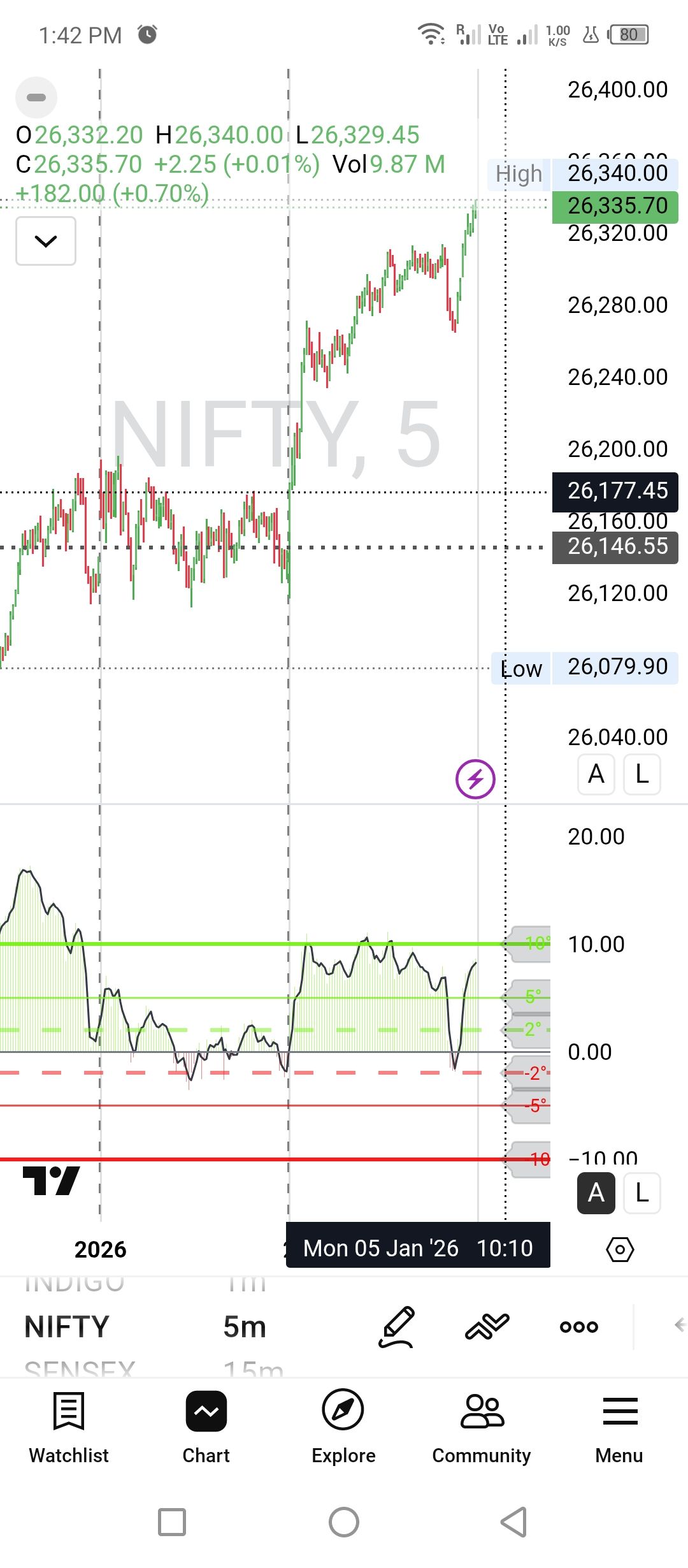
Right now using in trading view
Log in to comment and vote
Comments1
AJIT MADHUKARRAO SABANE
Jan 5
-2 deg to + 2 deg
Chop zone for price
Below above these trend established
Below and above -5/+5 deg trend run and above 10 deg exaution started as accumulation distribution
Today's move